Crumple Zone : Crash & Smash
- 3.7
- Rating
- 50.00K
- Installs
- Free
- Price
 Analysis by App-foxy
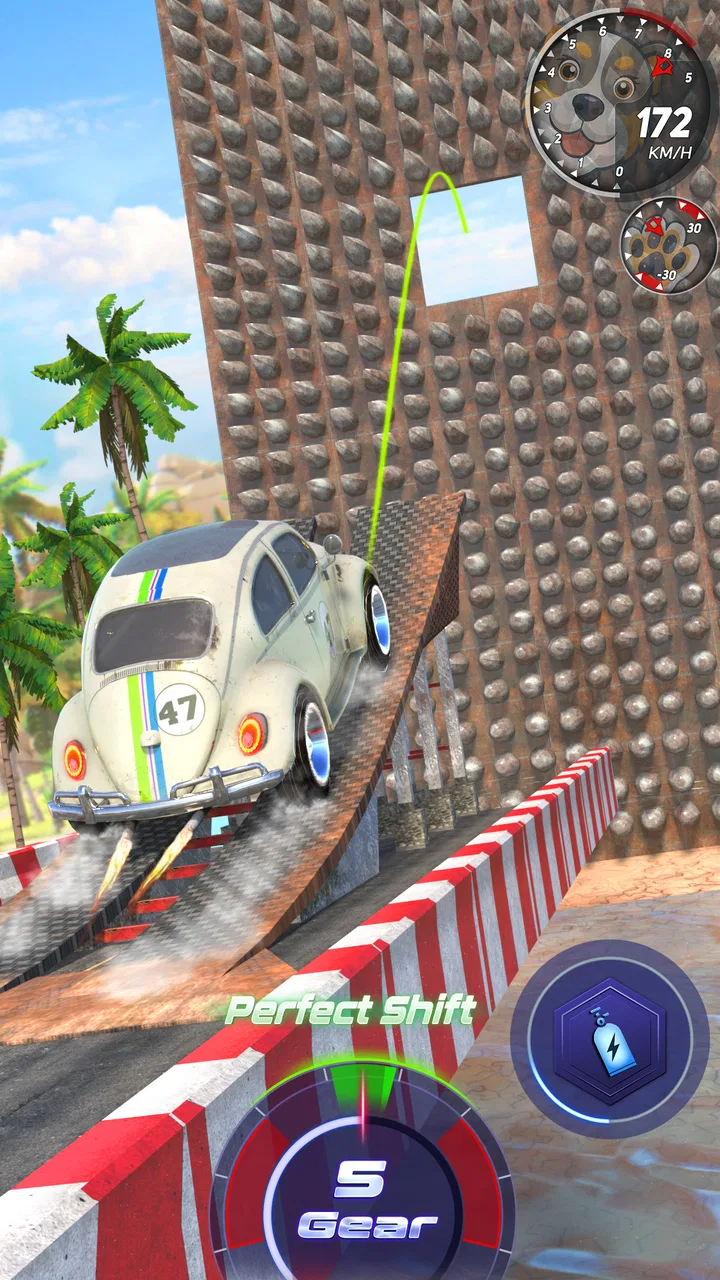
Crumple Zone: Crash & Smash is a racing game built around a simple but surprisingly thoughtful idea: getting a car into the air is only half the challenge. The real question is whether the jump was planned well enough to survive the landing. After spending time with it, I found a compact arcade experience that rewards timing, restraint, and a willingness to try the same stunt again with a slightly different approach.
That focus gives the game its personality. It is not trying to be a full driving simulator, a huge open-world racer, or a realistic motorsport package. Instead, it turns jumps and collisions into short tests of judgement. The store summary describes every jump as a calculated risk against nature, and that is a fair way to understand the central appeal without reducing the game to a simple crash toy.
Why the jump-and-crash idea works
The best part of the experience is the tension before the car leaves the ground. While driving toward a ramp, I am not only thinking about speed. I am also considering the angle of approach, the shape of the landing, and whether a spectacular leap is actually worth the danger. That makes each attempt feel more deliberate than a standard arcade race where acceleration is usually the obvious answer.
You May Also Like

 Pandora - Music & Podcasts
Pandora’s Music Is Easy to Start, but Harder to Recover
Pandora’s strength is its low-effort path from a seed to a station. Its weak spot is how much confidence it asks you to place in connection, setup, and quiet recovery.

 AccuWeather: Weather Radar
AccuWeather Review: A Quick, Clear Forecast for Everyday Decisions
For everyday plans, the best forecast is the one you can understand quickly. AccuWeather makes rain timing, radar, and local conditions easy to act on, with a few trade-offs.

 Hill Climb Racing
Why Hill Climb Racing Still Turns Crashes Into One More Run
A tiny car, a bumpy hill and one more upgrade: Hill Climb Racing keeps resurfacing because its simple chaos makes every near-miss feel personal.

 AliExpress - Shopping App
AliExpress Makes Global Shopping Feel Personal, but Shoppers Bear the Risk
AliExpress turns a global marketplace into a pocket-sized discovery engine. Its reach is useful, its shopping loop compelling, and its trade-offs easy to miss.

 Lords Mobile: Kingdom Wars
Lords Mobile Is a Kingdom-Building Routine, Not a Quick Match
A case-by-case verdict on the building, battles, device demands, and social commitments that make Lords Mobile rewarding for some players and exhausting for others.

 PDF Scanner app - TapScanner
TapScanner Makes Paperwork Easier to Capture, Check, and Share
TapScanner makes scanning with a phone feel less like a rescue operation and more like a dependable step in getting work done. Its capture tools are useful, though not flawless.
More From Our News Desk
View All News


A useful habit is to treat the first attempt on a jump as reconnaissance rather than a failure. I watch where the car lands, notice whether the front or rear takes the impact, and then adjust the next run. This approach is especially helpful for players who normally become frustrated when a racing game demands repeated attempts. Here, repetition has a clear purpose: each crash can reveal something about the route and the car’s behavior.
The game’s strongest moments come when a risky decision works. A cautious jump may keep the car intact but produce an ordinary result, while a faster or more aggressive launch can create a much better outcome if the landing is controlled. That trade-off gives the short racing format some welcome strategy. I never felt that simply holding the accelerator was enough to play well.
There is also a useful distinction between a visually impressive jump and a successful one. A car can travel a long distance and still lose because it lands badly. That encourages me to think about the complete movement rather than the launch alone. Players who enjoy mastering physics-based timing will probably get more from this than people looking for a traditional lap race with clear overtaking and cornering lines.
Small decisions matter more than reckless speed
My most practical tip is to avoid making every jump at maximum speed. A little less momentum can sometimes produce a cleaner landing, which is more valuable than a dramatic flight followed by a heavy impact. When a route repeatedly causes the car to nose-dive, changing the approach speed is often more useful than trying to force the same attempt harder.
I also found it helpful to separate two kinds of mistakes. If the car reaches the landing too early or too late, the problem is probably the launch timing. If it reaches the right place but lands awkwardly, the issue is more likely the angle or the way the car is being controlled in the air. Thinking about the mistake this way makes retries less random and helps turn frustration into a repeatable learning process.
Another non-obvious strength is how the crash itself can provide feedback. A failed landing is not just a punishment; it shows which part of the jump was poorly judged. That makes the game suitable for short sessions because even a brief play period can contain a small improvement. I can play for a few minutes, identify one mistake, and stop without feeling that I abandoned a long race halfway through.
What the presentation and format do well
The short description calls the game “Crumple Zone,” which fits its compact focus on damaged landings and risky driving. The experience feels designed around immediate interaction rather than a long introduction. I can understand the basic objective quickly, then spend my time improving decisions instead of learning a complicated set of systems.
That accessibility matters because the game is rated Everyone. A younger player can understand the appeal of launching a car and seeing what happens, while an older player can approach the same activity as a timing challenge. The accessible premise does not mean every attempt is easy, though. The deeper satisfaction comes from learning why a jump failed and changing the next run accordingly.
It is also a free game, which makes it easy to try without committing money at the start. There are in-app purchases ranging from $9.99 to $179.99 per item, so I would advise new players to treat the free entry as an opportunity to evaluate the core loop before spending anything. The purchase range is significant enough that anyone who dislikes optional spending should be especially careful around the store area and decide on a personal limit in advance.
That advice is not a criticism of the driving concept itself. It is simply part of deciding whether the game fits your habits. If you want a completely frictionless free experience with no temptation to buy extras, a premium racing game with one upfront cost may suit you better. If you prefer trying a game first and making your own decision later, the free starting point is convenient.
The weakness is variety, not the central idea
The same focused design that makes the game easy to understand can also make it feel narrow. Players who need a broad selection of race types, extensive vehicle tuning, deep career progression, or a large collection of tracks may find the experience limited compared with more established racing alternatives. I would not choose this as my only racing game if my main goal were long-term competitive progression.
Its appeal depends heavily on whether the jump itself remains interesting to you. At first, every failed landing invites another attempt. Over time, however, players who want constant novelty may begin to feel that they are repeating the same basic question: how can I launch the car and bring it down safely? The game needs the player to enjoy refinement, because the core pleasure comes from improving execution rather than moving through a large simulation.
This is where the comparison with usual racing games becomes important. A conventional arcade racer is usually better for quick overtaking, recognizable track layouts, and the excitement of racing directly against other vehicles. A realistic racer is better for players who care about braking points, tire behavior, and detailed vehicle control. Crumple Zone sits elsewhere. It is closer to a focused stunt challenge, where the landing is the main event and the route exists to create a decision.
For that reason, I would not recommend it to someone searching for a replacement for a full racing career mode. I would recommend it to someone who wants a lighter game to open between other activities, especially if they enjoy trial and error. The distinction is important: this is not a smaller version of every other racing game; it is a different kind of racing experience.
How I would use it in an ordinary day
Imagine having a short break while waiting for an appointment. A long race may be inconvenient because it asks for uninterrupted attention, but a jump-focused attempt is easier to fit into that gap. I can make a run, see the landing, and either retry immediately or put the phone away. That makes the game a good companion for brief sessions rather than a title that demands a full evening.
My preferred routine is to spend the first few attempts observing instead of chasing the most dramatic result. I look for the point where the car leaves the ramp, judge how much speed carries through the jump, and then make one change at a time. Changing everything at once makes it difficult to know what helped. This simple workflow turns the game into a small experiment and gives each retry more meaning.
It can also work as a casual challenge between friends, even without treating it like a formal multiplayer competition. One person can attempt a jump, explain what went wrong, and let the next person try a different approach. The fun comes from comparing decisions rather than only comparing speed. I would keep expectations modest, because the game’s strongest social value is the shared reaction to a spectacular success or an especially poor landing.
Who should try it and who should skip it
I think the best audience is made up of players who like physics-driven stunts, short arcade sessions, and gradual improvement. If you enjoy watching a failed attempt and immediately thinking, “I know what I will change next time,” the design has a good chance of holding your attention. It is also a reasonable choice for someone who wants a racing game that can be understood quickly without requiring knowledge of real motorsport.
It may be a good fit for families looking for an accessible car game, since the content rating is Everyone and the central idea is easy to explain. Younger players may enjoy the crashes for their visual impact, while adults can help them think about speed and landing position. I would still guide children around in-app purchases, particularly because individual items can be expensive relative to a casual game.
I would skip it if your priority is realistic driving. The game’s appeal comes from exaggerated jumps and controlled risk, not from reproducing the full discipline of road or track racing. I would also skip it if you dislike repeating a challenge after a failed attempt. The game asks for patience, and its rewards are tied to learning the same type of situation rather than constantly presenting a new genre mechanic.
Device compatibility is fairly approachable: the minimum operating system is Android 7.1, so owners of older supported Android devices may be able to try it. The current release is version 0.4, which also sets an expectation I would keep in mind. I approach it as a developing, focused game rather than as a finished, feature-heavy racing platform with years of accumulated content.
What the public response suggests
The game has an average rating of 3.7 from over 700 ratings, alongside more than 20 written reviews. I read that as a mixed but meaningful signal: enough players have formed clear opinions to show that the concept connects with some people, while the score also suggests that the experience will not satisfy everyone equally.
Its reach is still modest, with over 50 thousand installs. That makes it feel more like a discovery for players interested in unusual arcade ideas than an obvious mainstream racing choice. I would not use popularity alone to judge it, but the smaller audience reinforces my recommendation to try the free version and decide based on the jump-and-landing loop itself.
The developer is Simplyplay, and the game’s identity is clear even in its early version. I appreciate that it does not need a complicated explanation to communicate what makes it different. At the same time, the focused concept places pressure on execution and variety. If future updates expand the ways players can approach jumps without losing the simple premise, the game could become more appealing to people who currently find the loop too limited.
My final verdict
Crumple Zone: Crash & Smash succeeds when it treats every jump as a decision rather than a decoration. Its most enjoyable moments come from balancing speed against control, studying a failed landing, and making a small adjustment that turns the next attempt into a success. That is a stronger foundation than a generic crash gimmick, and it gives the game a clear reason to exist among racing titles.
Its limitations are equally clear. The focused structure will not replace a full arcade racer or a detailed driving simulator, and players who need broad content may lose interest. The in-app purchase range also means I would play the free version first and spend only if the core challenge genuinely earns that commitment.
My recommendation is specific: try it if you want a free, accessible racing game for short sessions and you enjoy learning through repeated jumps. Skip it if you want realistic handling, long races, or a large progression system. For the right player, the real reward is not the biggest crash, but the cleaner decision that prevents it.
FAQs for Crumple Zone : Crash & Smash
01What is Crumple Zone: Crash & Smash?
Crumple Zone: Crash & Smash is a physics-based destruction game focused on vehicle crashes, collisions, and spectacular damage effects. Players drive into obstacles, structures, and other objects to create chaotic wrecks while trying to complete objectives or achieve high scores. The main appeal is its casual, experimental gameplay rather than realistic racing, making it suitable for short sessions and players who enjoy destruction-based challenges.
02How do you play Crumple Zone: Crash & Smash?
Gameplay is generally built around controlling a vehicle and using momentum, timing, and positioning to cause as much damage as possible. Depending on the stage, you may need to hit specific targets, destroy parts of an environment, or produce a powerful crash. Controls are designed to be approachable, so you can usually start playing quickly, although mastering angles, speed, and impact points takes more practice.
03Is Crumple Zone: Crash & Smash free to download?
The game can typically be downloaded without an upfront purchase, but availability, advertising, and optional in-app purchases may vary depending on the Android or iOS version and your region. Before installing, check the store listing for details about paid items, ad removal, and any subscription terms. Reviewing these details is recommended if the game will be played by children or on a shared device.
04Can Crumple Zone: Crash & Smash be played offline?
Many destruction-focused levels may work without a constant internet connection, which makes the game convenient for travel or quick offline sessions. However, advertisements, analytics, cloud features, updates, or certain online services may require connectivity. Offline behavior can also differ between versions, so it is best to launch the game once while connected and test the features you plan to use before relying on it without internet access.
05Is Crumple Zone: Crash & Smash suitable for children?
The game presents crashes and vehicle destruction in an arcade-style format rather than as a realistic driving simulator, so its content is generally less intense than graphic action games. Even so, parents should review the age rating, advertising, in-app purchase options, and privacy information shown on the relevant app store. Younger players may also need supervision because repeated gameplay can encourage optional purchases or extended screen time.
Pros
- Simple controls make it easy to start playing immediately.
- Short crash sessions are ideal for quick breaks.
- Vehicle damage effects make collisions feel satisfying.
- Unlockable cars add variety and encourage continued play.
- Works well for players who enjoy casual destruction games.
Cons
- Gameplay can become repetitive after extended sessions.
- Progression may feel slow without frequent play.
- Some vehicles or upgrades may require considerable grinding.
- Crash scenes can become visually cluttered during large impacts.
- The game may appeal less to players seeking deep racing mechanics.

Crumple Zone : Crash & Smash
Gallery